Promoted to Senior Postdoctoral Scholar at Caltech
Since September 2026 I am a Senior Postdoctoral Scholar Research Associate in Physics at Caltech.
Space physicist · Caltech
I follow energetic particles from the Sun to the Moon, with data from Parker Solar Probe, Solar Orbiter, IMAP and Chang’E-4.
Solar energetic particlesCME-driven shocksCosmic rays in the heliosphereThe lunar radiation environmentSpace weather and machine learning
 ☀️
(he/him)
Senior Postdoctoral Scholar Research Associate in Physics
Ph.D. in Space Physics (Dr. rer. nat.)
2018-09-01
2023-08-01
Kiel University, Germany
M.S. in Astrophysics
2015-09-01
2018-06-30
Nanjing University, China
B.S. in Space Science and Technology
2011-09-01
2015-06-30
School of Astronomy and Space Science, Nanjing University, China
Publications
7 first / co-first author · 2 in Science Advances
Citations
h-index 20 · Google Scholar
Space missions
PSP · Solar Orbiter · IMAP · Chang'E-4
Invited talks
AGU 2025 & 2026 · Solar Orbiter WG
From the Sun’s corona to the surface of the Moon — following energetic particles through the heliosphere.
How CME-driven shocks and flares accelerate particles, seen by spacecraft at different distances from the Sun.
Radial gradients and modulation of anomalous and galactic cosmic rays between 0.3 and 1 au.
Primary and albedo particles, SEPs and cosmic-ray shadowing measured on the Moon's far side.
Radiation-risk assessment for exploration and data-driven SEP forecasting.
Calibrating particle telescopes and modelling their response with Geant4 — from LND on the Moon to HET and EPI-Hi in space.
Where SEPs start — coronal shock waves, flare statistics and radio bursts, the topic of my first papers at Nanjing.
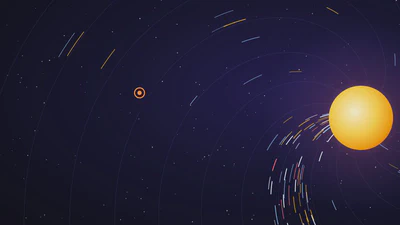
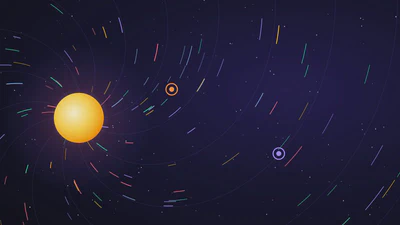
I work with particle detectors on four missions, from 9.86 solar radii to the far side of the Moon. Pick one to see where it flies and what I do with its data.
NASA · launched 2018
Closer to the Sun than any spacecraft before it, 9.86 solar radii (0.046 au), once every 88 days.
Member of the IS⊙IS/EPI-Hi team since 2023. I study solar energetic particle events with inverse velocity arrival, and events seen by several spacecraft at once.
My work with Parker Solar Probe →ESA & NASA · launched 2020
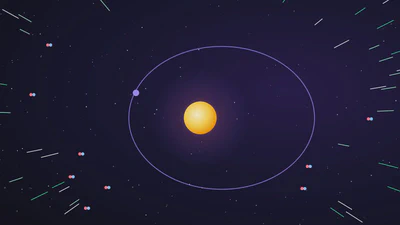
Comes within about 0.3 au of the Sun on an increasingly tilted orbit, carrying the Energetic Particle Detector (EPD).
EPD/HET team member, 2020–2023. Cross-calibration, cosmic-ray radial gradients, and the first observations of anomalous cosmic-ray helium in the inner heliosphere.
My work with Solar Orbiter →NASA · launched 2025
Watches the solar wind and energetic particles from the Sun–Earth L1 point, 1.5 million km sunward of Earth.
Member of the High-Energy Ion Telescope (HIT) team since launch.
My work with IMAP →CNSA · landed 2019
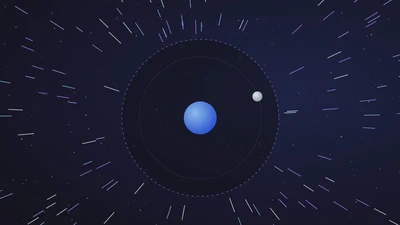
The first landing on the far side of the Moon, carrying the Lunar Lander Neutron and Dosimetry experiment (LND) built at Kiel University.
LND project manager, 2019–2023. The first solar energetic particle event measured on the far side, albedo protons, and a cosmic-ray cavity in Earth–Moon space.
My work with Chang'E-4 →
Orbits to scale (Earth = 1 au); Earth–Moon system enlarged. Clock speeded up: one Earth year ≈ 90 s.
Since September 2026 I am a Senior Postdoctoral Scholar Research Associate in Physics at Caltech.
I co-convened Session 13, “Dynamics of Particle Populations Throughout the Inner Heliosphere”, at the SHINE 2026 workshop in Madison, Wisconsin.
Our anomalous cosmic-ray helium result was featured as Solar Orbiter Science Nugget #95 by ESA.
My first-author paper cataloguing 14 inverse-velocity-arrival SEP events observed by PSP/IS⊙IS is published in Astronomy & Astrophysics.
A catalogue of 14 PSP/IS⊙IS SEP events in which mid-energy (mostly 0.5–5 MeV) particles arrive before both slower and faster ones.

First measurement of the radial gradient of anomalous cosmic-ray helium between 0.3 and 1 au with Solar Orbiter/EPD/HET (≈22%/au, ≈32%/au after removing the GCR contribution).
Chang'E-4/LND data reveal a ~20% deficit of galactic cosmic-ray protons in part of the Moon's orbit, caused by Earth's magnetosphere shadowing cosmic rays. Co-first author.
Composition variation of the 2023 May 16 SEP event observed by Solar Orbiter and Parker Solar Probe.
Detection and analysis of primary and albedo protons by the Lunar Lander Neutron and Dosimetry (LND) experiment on Chang'E-4's lunar farside.
41 peer-reviewed papers · 7 as first or co-first author
Complete list on NASA ADS · Google Scholar
Live readings from NOAA’s GOES satellites — the same kind of energetic-particle data I work with every day. Toggle energy channels to compare.
Loading live data from NOAA SWPC…
Promoted to Senior Postdoctoral Scholar Research Associate in Physics.
Inverse-velocity-arrival SEP events (A&A), anomalous cosmic-ray helium (A&A), and a cosmic-ray cavity in Earth-Moon space (Science Advances).
Session 13, Dynamics of Particle Populations Throughout the Inner Heliosphere; my ACR helium result featured as an ESA Solar Orbiter Science Nugget.
Project manager of Chang’E-4/LND and member of the Solar Orbiter EPD/HET team.
First paper on coronal shocks and solar energetic particles (ApJ 2017).
Invited presentation at the Solar Orbiter WG on Energetic Particles, Shocks and Solar Activity.
Invited talk on SEP events whose mid-energy particles arrive first — what Parker Solar Probe and Solar Orbiter tell us about shock acceleration near the Sun.
Poster (SH33C-2743) at AGU Fall Meeting 2024.
Open to collaborations on energetic particles, space radiation and space weather.
Space Radiation Laboratory
California Institute of Technology
Pasadena, CA, United States