Parker Solar Probe / IS⊙IS — Energetic Particles Near the Sun
Jun 1, 2026
·
1 min read
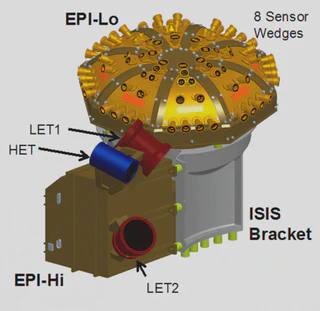
NASA’s Parker Solar Probe flies closer to the Sun than any spacecraft before it. Its IS⊙IS suite measures energetic particles; Caltech leads the high-energy part, EPI-Hi.
My role
Postdoctoral member of the EPI-Hi team at Caltech since 2023, working with Dr. Christina Cohen. I analyse SEP events seen by PSP and combine them with Solar Orbiter, STEREO and ACE to follow particles from near the Sun to 1 au. This work is part of the team recognised with a NASA Group Achievement Award.
Key results
- Inverse-velocity-arrival (IVA) events — a catalogue of 14 SEP events where mid-energy particles arrive first, probing shock acceleration near the Sun (first author, A&A 2026; invited talk at AGU 2025).
- Composition variation in the 2023 May 16 SEP event seen by both Solar Orbiter and PSP (first author, ApJL 2024).
- Co-author of studies on radial dependence of SEP fluences, Fe-rich multi-spacecraft events, shock properties of IVA events, and deep-learning SEP prediction with PSP/IS⊙IS data (JGR: Machine Learning and Computation, 2026).

Authors
Zigong Xu
(he/him)
Senior Postdoctoral Scholar Research Associate in Physics
I study how the Sun accelerates particles to high energies and what those particles — together with galactic and anomalous cosmic rays — do to the radiation environment of the inner heliosphere and the Moon. I work hands-on with instrument data from NASA’s Parker Solar Probe (IS⊙IS/EPI-Hi) and IMAP (HIT), ESA’s Solar Orbiter (EPD/HET), and China’s Chang’E-4 lander (LND), combining multi-spacecraft observations, Geant4 simulation, statistics and machine learning to understand solar energetic particle events and assess radiation risk for space exploration.