Solar Orbiter / EPD-HET — Cosmic Rays from 0.3 to 1 au
Apr 1, 2026
·
1 min read
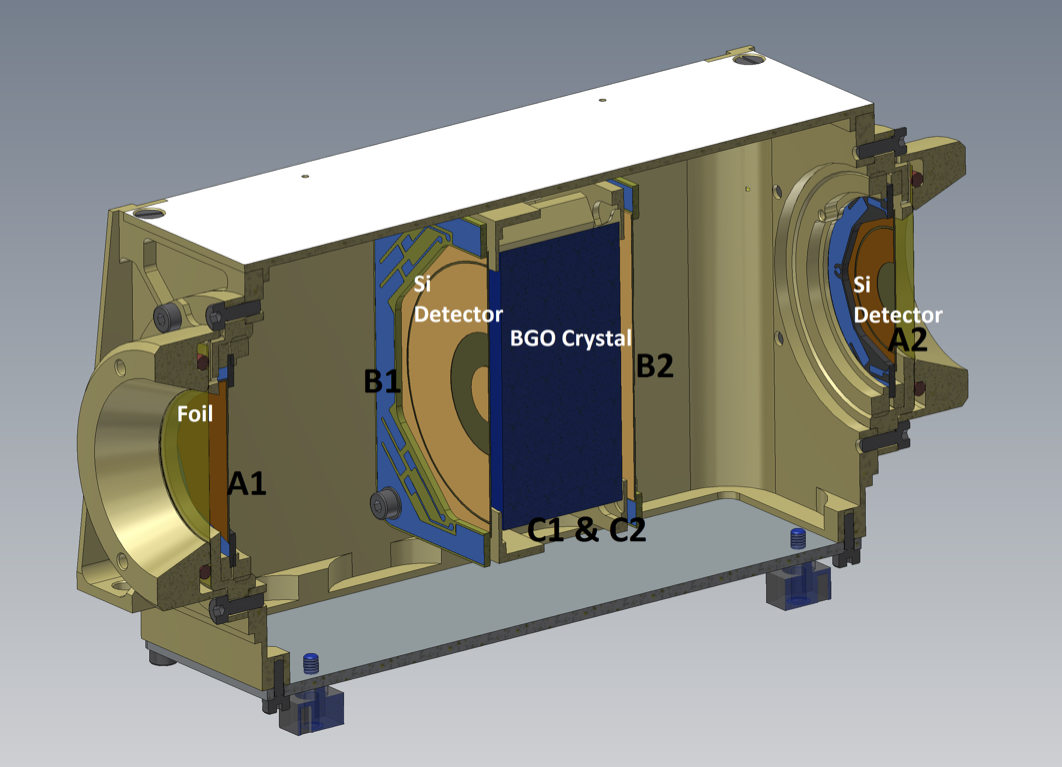
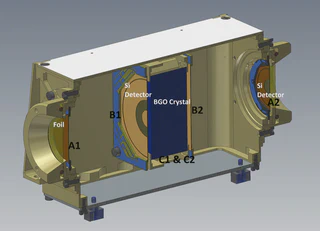 Cut-away of the High Energy Telescope: silicon detectors A1/A2, B1/B2 and the BGO calorimeter C.
ESA/NASA’s Solar Orbiter carries the Energetic Particle Detector (EPD). Kiel University built its High Energy Telescope (HET), which measures protons and heavier ions up to hundreds of MeV/nucleon with silicon detectors and a BGO scintillator.
My role
Member of the EPD/HET team at Kiel (2020–2023): HET data analysis and cross-calibration with other instruments, and studies of large, widespread SEP events — work I continue in collaboration from Caltech.
Key results
- Anomalous cosmic-ray helium in the inner heliosphere — first radial gradient of ACR helium between 0.3 and 1 au, ≈22%/au (≈32%/au with the GCR contribution removed), increasing with solar modulation (first author, A&A 2026).
- 🌟 Featured by ESA as Solar Orbiter Science Nugget #95 — “Anomalous cosmic rays within the inner heliosphere: first observations of ACR helium by Solar Orbiter/HET” (June 2026). The nugget shows that HET’s quiet-time helium spectra agree well with other instruments, and that the measured gradients are consistent with Parker Solar Probe, pointing to different particle transport inside 1 au than farther out.
- Co-author of Solar Orbiter’s First Results special issue papers (A&A 656, 2021) and many multi-spacecraft SEP studies, including ³He-rich events and widespread events.

Authors
Zigong Xu
(he/him)
Senior Postdoctoral Scholar Research Associate in Physics
I study how the Sun accelerates particles to high energies and what those particles — together with galactic and anomalous cosmic rays — do to the radiation environment of the inner heliosphere and the Moon. I work hands-on with instrument data from NASA’s Parker Solar Probe (IS⊙IS/EPI-Hi) and IMAP (HIT), ESA’s Solar Orbiter (EPD/HET), and China’s Chang’E-4 lander (LND), combining multi-spacecraft observations, Geant4 simulation, statistics and machine learning to understand solar energetic particle events and assess radiation risk for space exploration.